IPTA

The IPTA training system

The IPTA PRIME Method

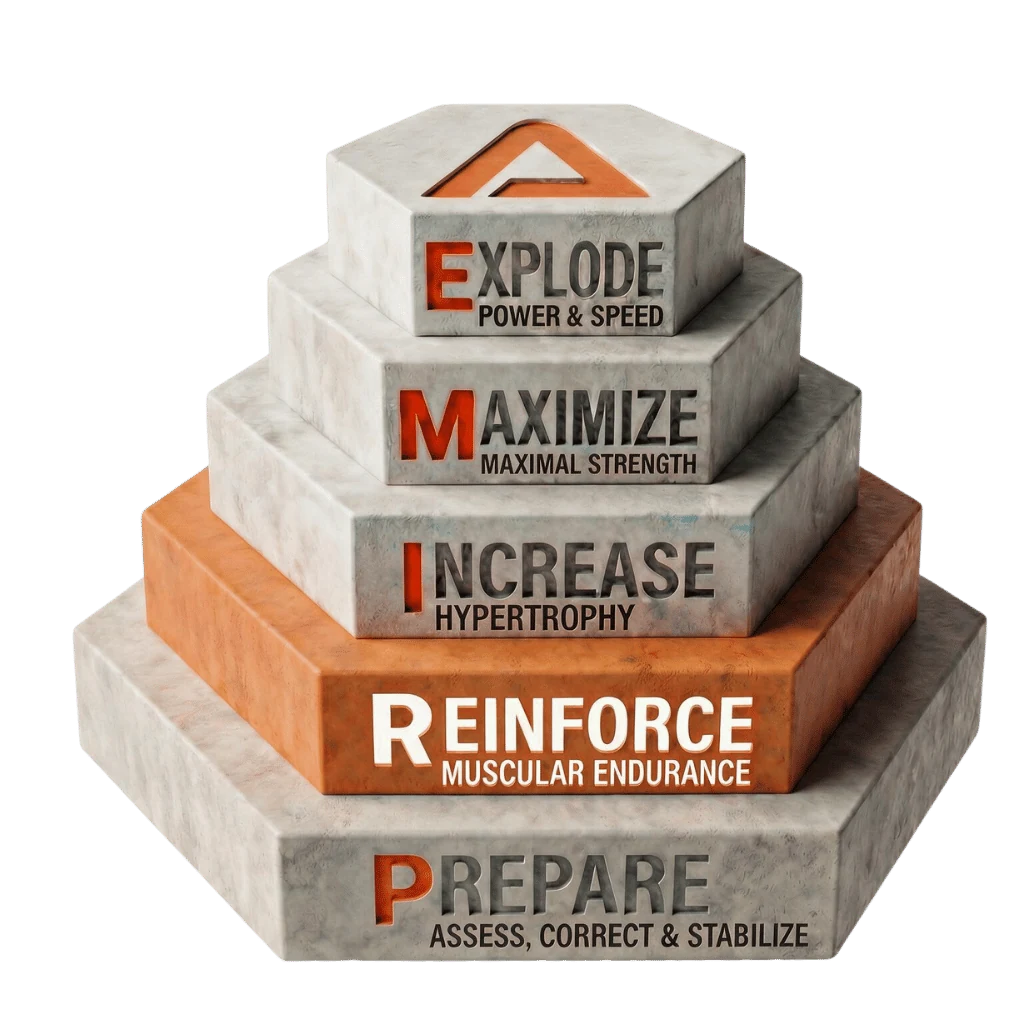
Five phases. Two preparation zones. One path you can actually run with a client on Monday morning — Prepare, Reinforce, Increase, Maximize, Explode.

PRIME is taught in full inside the NCCA-accredited IPTA CPT. This page is the whole method, phase by phase, with what each one builds, when a client enters it, and what has to be true before they leave.

Get CPT Certified
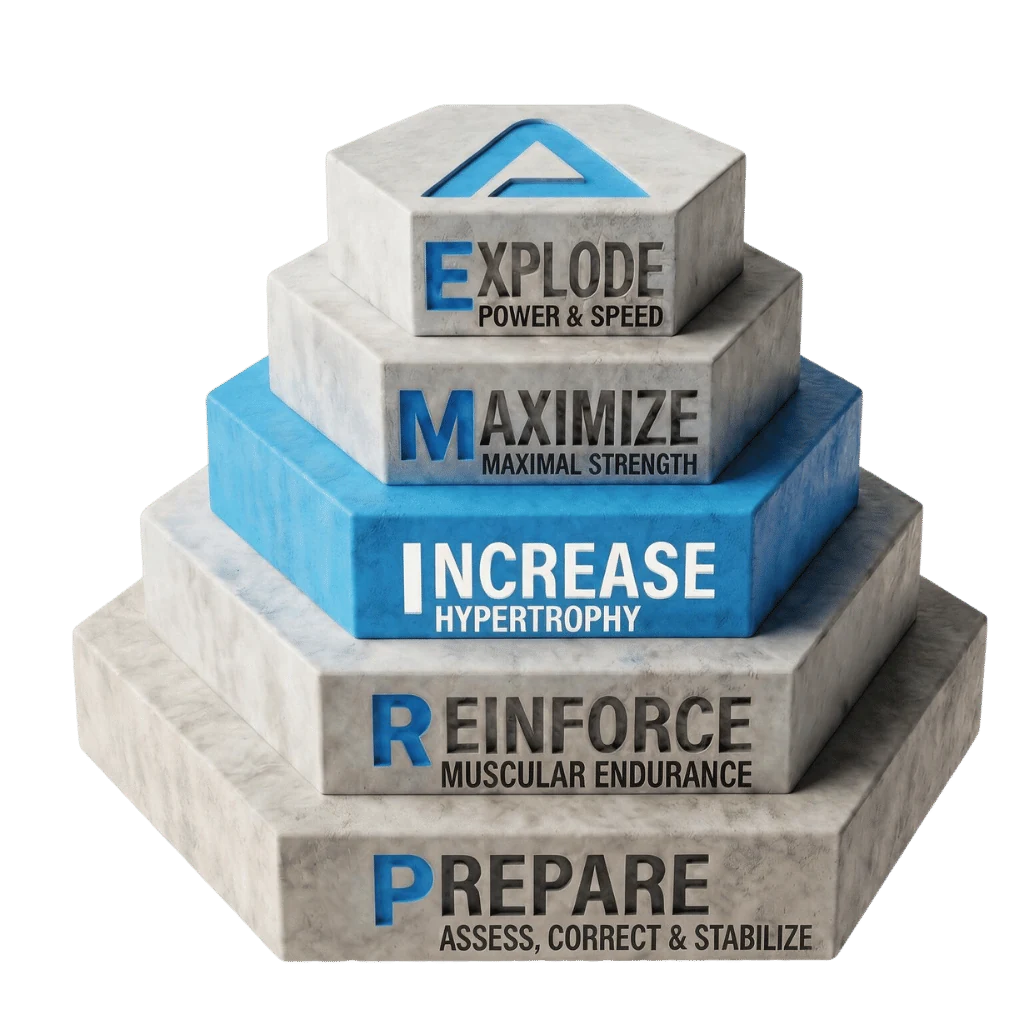
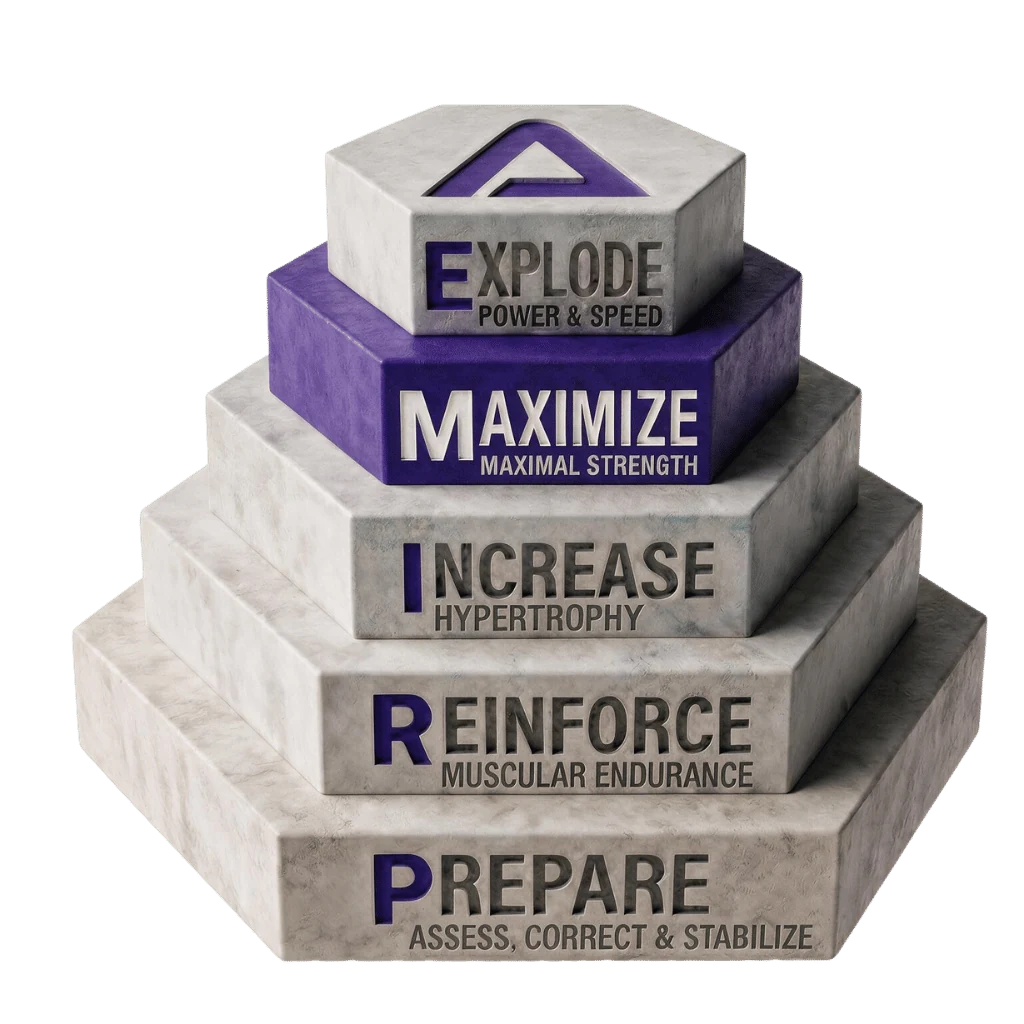
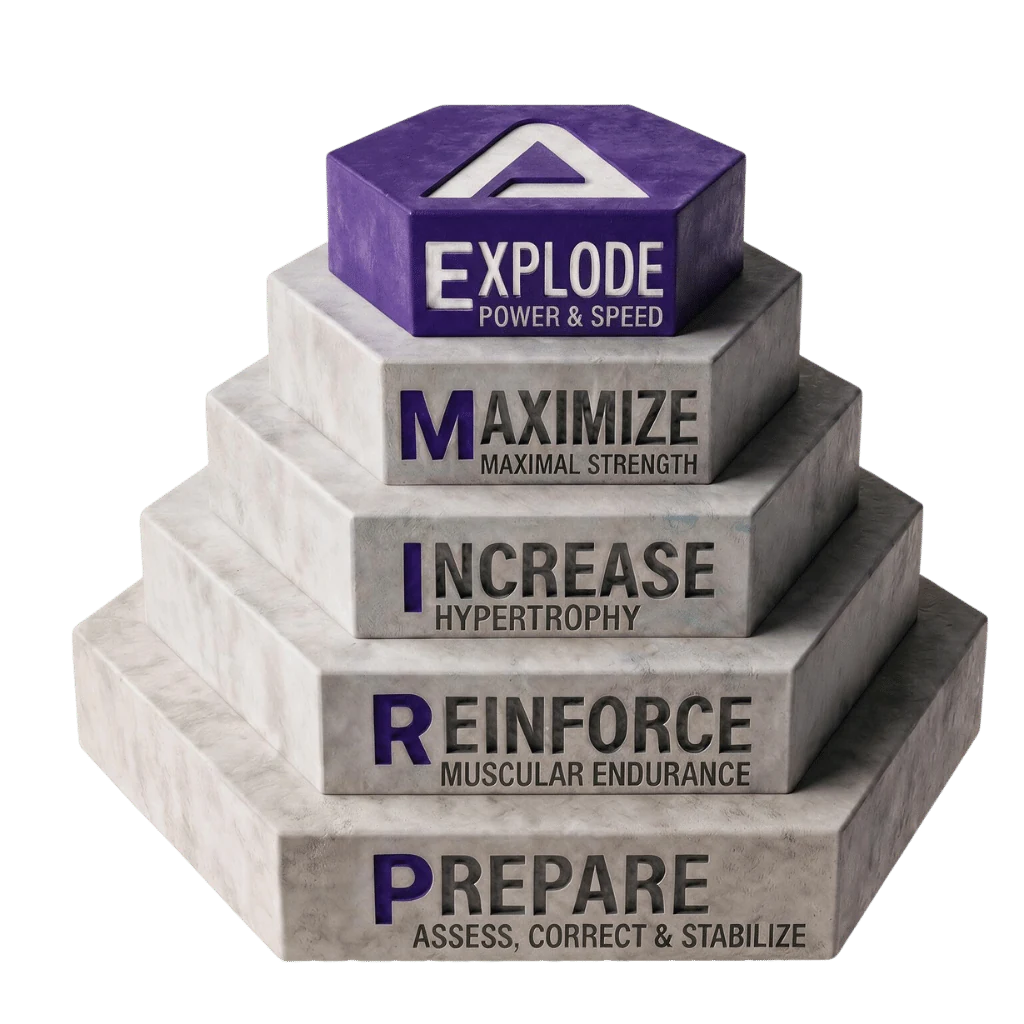
The IPTA PRIME Method pyramid — the five phases of the PRIME method: Prepare, Reinforce, Increase, Maximize, Explode

Most certifications teach you Anatomy, then hand you a client

You finish the exam knowing the origin and insertion of a muscle you will never name out loud again, and you still do not know what to write on the whiteboard for the 6am client with a cranky shoulder who wants to look better by June. The gap is not knowledge. The gap is sequence — which quality to train, in what order, and how you know it is time to move on.

PRIME closes that gap. It is not a rebrand of the training you already know; it is the order that training goes in, with the decision points written down.

The science behind the pyramid — Two Zones

Every training plan ever written moves through two zones. PRIME turns them into one teachable client path.

GPP
General Physical Preparation

Prepare + Reinforce. The broad base: movement quality, stability, muscular endurance, work capacity. Wide rather than deep, and the zone the large majority of paying clients live in permanently.

SPP
Specific Physical Preparation

Maximize + Explode. The specialization path toward one dominant adaptation. Narrow, heavy, and only appropriate once the base underneath it is real — which is a judgement call PRIME gives you criteria for.

Where does Increase sit? It is the crossover — and that is the point.

Hypertrophy is the phase that changes zone depending on who is in front of you. For a general client it is the top of the general base. For a physique client it is the specific goal. Classical periodization has always put the hypertrophy block at exactly that seam, between anatomical adaptation and maximal strength — which is why the Bodybuilding Specialist exists as its own deep dive rather than as a chapter inside strength training.

These two zones are not ours. They were formalised by Leonid Matveyev from his study of Olympic athletes and refined by Tudor Bompa, and 62 years later they remain the most researched and most widely used framework in training science. What is ours is PRIME: the five phases that turn two academic zones into something you can coach.

The five phases, One By One

What each phase builds, when a client enters it, and what has to be true before they leave.

PPrepareAssess, correct & stabilizeGPP

What it builds. Movement quality, joint position, trunk stability and the plain ability to tolerate training at all.

Almost every injury and plateau a trainer meets later was invited during this phase, by skipping it. A client who cannot hinge without their lower back taking over does not need a heavier deadlift — they need six weeks of this.
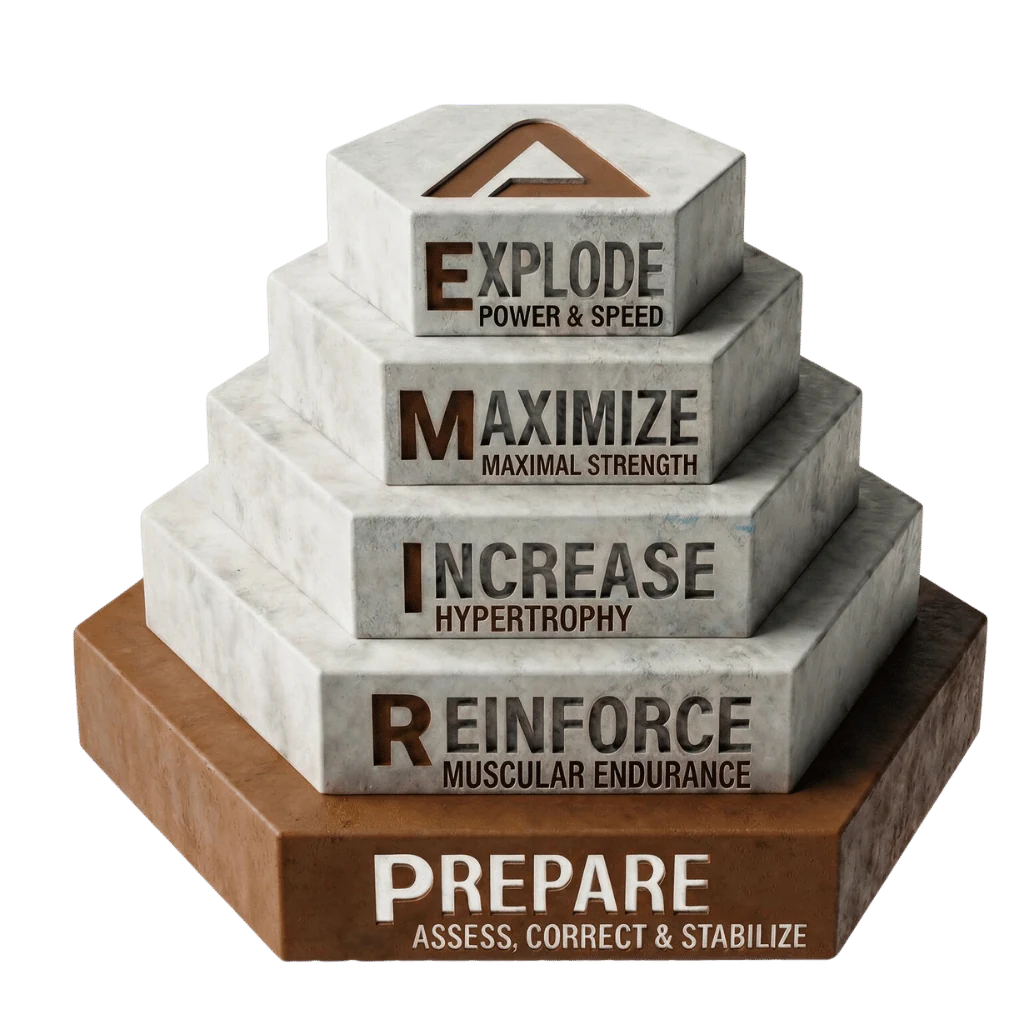
The PRIME pyramid with the Prepare step highlighted
Enter when

Everyone, day one. Returning clients re-enter here after a long layoff, an injury, or any surgery.

Move on when

The five primary patterns — hinge, squat, push, pull, carry — performed with control at light load, with no compensation you have to coach away every rep.

A week looks like

2–3 full-body sessions. Movement screen re-checked weekly. Tempo and isometric work, 12–20 reps at loads that never threaten technique. Daily mobility on the two restrictions you actually found.

Goes deeper in: Corrective Exercise Specialist (CES) — optional, never required.
RReinforceMuscular enduranceGPP

What it builds. Repeatable capacity — connective tissue tolerance, aerobic base, and the work volume every later phase is paid for with.

This is the least glamorous phase and the one that decides whether a client can train three times a week for a year instead of twice a week for a month. Tendons and ligaments adapt slower than muscle; this is where you let them catch up.

The PRIME pyramid with the Reinforce step highlighted
Enter when

Patterns are clean at light load and the client recovers between sessions.

Move on when

Form holds for 15–20 reps across three sets, and session-to-session soreness has stopped dictating the schedule.

A week looks like

3 full-body sessions. 2–3 sets of 12–20 with short rest, 30–60 seconds. Circuits and carries. Conditioning added deliberately rather than as punishment.

Taught only in the CPT. There is no separate deep-dive certification for this phase — the CPT is where you learn it.

IIncreaseHypertrophyGPP → SPP

What it builds. Muscle cross-section — the raw material that every phase above it spends.

Strength and power are, in part, a function of how much muscle there is to recruit. This is also the phase most general clients actually want, whether or not they use the word hypertrophy. Skipping it and going straight to heavy triples is how trainers build clients who are strong on one lift and fragile everywhere else.

The PRIME pyramid with the Increase step highlighted
Enter when

An endurance base is built and technique survives fatigue, not just the first clean set.

Move on when

Measurable change in size or working load, and the client can take a set of 8–12 close to failure without technique falling apart.

A week looks like

4 sessions on an upper/lower split. 3–4 sets of 8–12, 60–90 seconds rest, load or reps going up week over week. Effort tracked, not guessed.

Goes deeper in: Bodybuilding Specialist (CBS) — optional, never required.

MMaximizeMaximal strengthSPP

What it builds. Neural drive and force production — teaching the body to use the muscle it has.

Strength is a skill before it is a size problem. This phase is where intent, bracing and bar speed get coached, and where a client stops adding weight by grinding and starts adding it by being better at the lift.

The PRIME pyramid with the Maximize step highlighted
Enter when

Enough muscle to be worth recruiting, and technique that does not change when the load does.

Move on when

Consistent top sets of 3–5 with bar speed maintained across every rep, not just the first.

A week looks like

3–4 sessions. 3–6 sets of 2–5 in the 80–90% range with 2–4 minutes of real rest. Accessory work kept in for the tissue built in Increase.

Goes deeper in: Strength & Conditioning Specialist (SCS) — optional, never required.

EExplodePower & speedSPP

What it builds. Rate of force development — how much of that strength arrives in the fraction of a second a sport gives you.

Power is strength expressed quickly. It sits at the top of the pyramid because it is the phase with the shortest shelf life and the highest prerequisite; run it on a client without a strength base and you are training the injury, not the athlete.

The PRIME pyramid with the Explode step highlighted
Enter when

A genuine relative-strength base — a squat around 1.5× bodyweight is the marker most coaches use — and no unresolved pain.

Move on when

This is the peak. You hold it briefly, then cycle back down the pyramid rather than living here.

A week looks like

2–3 sessions. Jumps, throws and Olympic derivatives early while fresh, 3–5 sets of 2–5 with full recovery. Strength work reduced to maintenance, never dropped.

Goes deeper in: Strength & Conditioning Specialist (SCS) — optional, never required.

All five phases are in the CPT

PRIME originates with the IPTA CPT and is taught there in full. You do not need a specialty certification to run it, and you do not need one to get hired — the NCCA-accredited credential, the Job Assurance Guarantee and the complete method all come with the CPT.

What the specialties do is go further into one phase than a foundational certification has room to. Take note of the order though: depth is only worth buying once the sequence itself is second nature.

The PRIME pyramid with every phase covered by a specialty certification
Every phase, in depth

The full PRIME Stack

PrepareCorrective Exercise (CES)
ReinforceCPT only — no deep dive
IncreaseBodybuilding Specialist (CBS)
Maximize + ExplodeStrength & Conditioning (SCS)

Four certifications cover PRIME end to end: the CPT, plus corrective, bodybuilding and strength & conditioning. That is the Elite Trainer package. Reinforce is the one phase with no deep dive of its own — it is taught inside the CPT.

Nutrition and group coaching are not PRIME phases. They are separate disciplines with their own IPTA systems — nutrition runs on FUELS and group coaching runs on TEACH — so they sit alongside PRIME rather than inside it.

Build Your Own IPTA Bundle

Read the whole method Free

PRIME is taught end to end in the IPTA CPT textbook. Read it in our online reader before you decide anything — the complete book, not a sample, and no payment details.

Or see the CPT certification — two full certifications for the price of one.