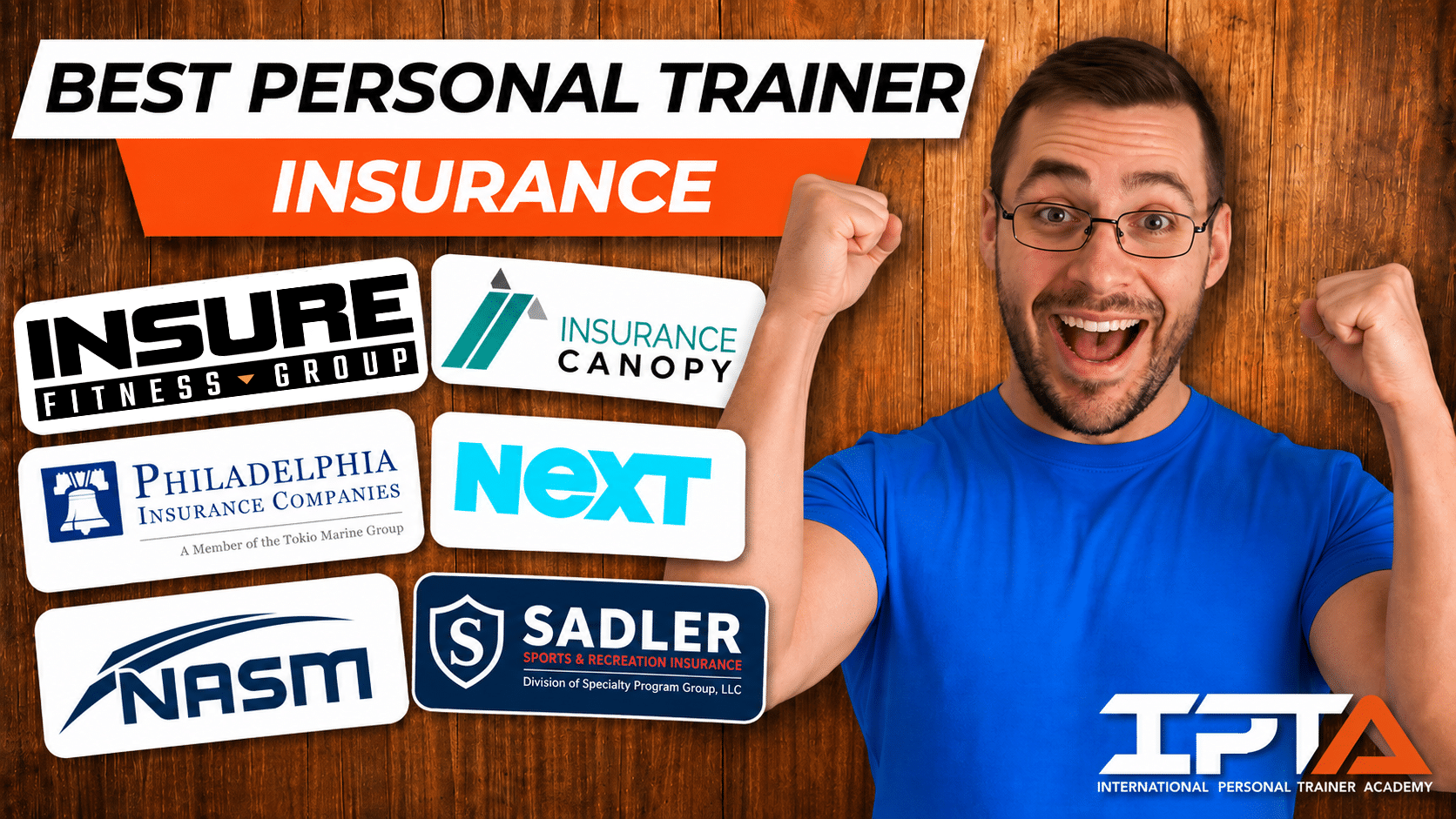








Personal trainer insurance providers fall into two clean buckets, and your choice depends on which bucket fits the way you actually run your business.
The first bucket is fitness-specific carriers — companies like Insure Fitness Group and Insurance Canopy that exist primarily to insure trainers, yoga instructors, and fitness pros. They tend to offer a flat annual rate, a long pre-approved activity list, and trainer-specific extras like identity theft and SAM coverage baked in or available as add-ons.
The second bucket is general small-business carriers — Philadelphia Insurance, NEXT, Hiscox — that insure thousands of professions and treat personal training as one vertical among many. They shine when your business has needs beyond liability (workers’ comp, commercial auto, BOP, multi-trainer payroll) but typically charge more for the same headline limits.
For most independent personal trainers, the right choice comes down to whether liability is the only coverage you need, or whether liability is one piece of a broader business-insurance stack you’re building.
By the way, be sure to take our helpful quiz to find out the best personal trainer certification for you.

Which is the best-priced personal trainer certification for you?
We created this essential quiz to help you choose the perfect certification for YOU based on your goals, learning style, price, and more.
Simple Decision Rule
If you’re a solo trainer start with either Insurance Canopy or Insure Fitness Group.
Best Personal Training Insurance Compared
| Provider | Starting Price | Best If | Not Best If |
|---|---|---|---|
| Insurance Canopy | $159/yr | Want customizable add-ons and monthly billing | Prefer a simple, all-in policy |
| Insure Fitness Group | $189/yr | Want a strong fixed base coverage | Want monthly billing |
| Philadelphia Insurance | $172/yr | Train kids/vulnerable populations | Want quick digital signup |
| NEXT Insurance | ~$128/yr | Need multi-policy bundling | Only need liability |
| NASM Insurance | ~$132/yr | Currently NASM-certified | Certified elsewhere |
| Sadler Sports & Rec | $194/yr | Do group/corporate work | Solo one-on-one only |
What Personal Trainer Insurance Actually Covers
Skip ahead to the first review if you already know the basics.
A personal trainer insurance policy bundles two coverages every working trainer needs:
- General Liability (GL) — pays out if a client (or anyone else) is physically injured or has property damaged because of your business activity.
- Professional Liability (PL) / Errors & Omissions — pays out if a client claims your advice or instruction caused them harm or financial loss.
Stronger policies layer in optional protection: identity theft, sexual abuse and molestation (SAM), cyber liability, equipment / inland marine, and product liability for trainers selling supplements or branded gear. The providers below are evaluated on how well their base policies handle these layers, not on what’s possible after a long list of endorsements.
Average annual cost in 2026: $120–$400 for a solo personal trainer. Anything below $150/year is on the low end of the market; anything above $400 should come with substantial extras.
How We Evaluated These Providers
Trainer Academy weighed each provider against five criteria:
- Coverage breadth — Activities and modalities included without endorsement.
- Price-to-value — Annual premium relative to limits and bundled extras.
- Carrier strength — AM Best rating and claims-payment reputation.
- Portability — Whether coverage follows you across gyms, online sessions, and state lines.
- Trainer-specific extras — Identity theft, SAM, cyber, equipment, and additional-insured handling.
We don’t score providers numerically. We tell you which one fits which trainer, and where each option starts to break down.
Insurance Canopy
Choose Insurance Canopy if: you want the most coverage options, or you need monthly billing.
Insurance Canopy is the best choice for trainers who want to customize their insurance plan. Base policies start at $159/year (or $15/month, with a ~13% discount for paying annually) and include $1M-per-occurrence / $3M-aggregate general and professional liability.
The differentiator is the add-on menu. Canopy lets you bolt on Sexual Abuse and Molestation (SAM) coverage, cyber liability, equipment / inland marine, diet & nutrition coverage, and additional insureds individually. That makes it a strong fit for trainers who have outgrown a vanilla policy — supplement sellers, online coaches storing client data, mobile trainers hauling expensive gear, or anyone training in a high-risk modality (CrossFit, hot yoga, kickboxing).
Tradeoffs to know
A fully-loaded Canopy policy stops being cheap. Once you’ve added SAM, cyber, and equipment, you’re often north of $300/year. SAM is also an add-on, not included in base.
Strengths
- True monthly billing option ($15/month)
- Largest menu of optional coverages on this list
- Comfortable with high-risk modalities by default
- Transparent online quoting and pricing
- Coverage for online and in-person training included
Weak spots
- SAM is an add-on, not included in base
- Identity theft isn’t standard
- À la carte adds up faster than expected
Bottom Line
Canopy is the right pick when you know your business will grow over time and have specific policy needs— supplements, multi-modality training, sensitive client data, expensive portable equipment. Also, the monthly billing option means you won’t need a huge upfront investment to get going. At $15/month, Insurance Canopy makes it easy to get insured.
Insure Fitness Group
Choose Insure Fitness Group if: you’re a working personal trainer who wants a strong base-policy coverage at one annual price, with zero math required.
If Canopy wins on flexibility, Insure Fitness Group (IFG) wins on the strength of its base plan. Everything most trainers need is already included — no add-ons to price out, no math to do. It’s the most complete out-of-the-box policy on this list, which makes it the top choice for anyone who’d rather set coverage once and forget it.
You get $1M-per-occurrence / $3M-aggregate general and professional liability on an occurrence form, identity theft coverage up to $25,000, and access to over 500 pre-approved fitness activities and training methods. The policy follows you across all 50 states whether you’re training at a commercial gym, a private studio, a park, a client’s home, or online.
Tradeoffs to know
The main friction point is billing: IFG bills annually only. You’ll see the full $189 (or $65 for student trainers) up front. Also Insurance Fitness Group doesn’t offer cyber coverage, which means some online trainers will need to go in a different direction.
Strengths
- $1M / $3M occurrence-form GL + PL — the gold-standard form
- $25,000 identity theft coverage included at no extra cost
- 500+ activities pre-approved (no endorsement calls)
- Truly portable across gyms, online sessions, and state lines
- Same-day digital COI; additional insureds easy to add
- Student trainer discount as low as $65/year
- A-rated underwriting carrier (AM Best)
Weak spots
- Annual billing only — no true month-to-month plan
- No native cyber liability coverage (rarely needed for solo trainers)
Bottom Line
For a working independent trainer, the math is hard to argue with. $189/year for occurrence-form $1M/$3M liability with identity theft with 500+ activities with nationwide portability is among the highest-value base policy on the market.
Philadelphia Insurance (PHLY)
Choose PHLY if: you train kids, run a studio, or work in a niche where sexual misconduct exposure is real.
Philadelphia Insurance Companies (PHLY) is the largest carrier on this list and the only one that bundles sexual misconduct liability into the base policy rather than charging for it as an add-on. For a working trainer in a one-on-one studio environment, that’s not a small detail.
Pricing is $172/year for certified trainers ($232/year for non-certified), inclusive of a $50 Risk Purchasing Group fee. Limits are $1M/$3M, deductible is $0 on general liability, and the policy covers virtual and in-person training in multiple states. PHLY is also the natural step up if your business is heading toward a brick-and-mortar studio — they have dedicated programs for studio owners and gym operators.
The trade-off: PHLY’s signup experience is more old-school than the digital-native carriers. Expect to provide certification verification and work through a slightly slower flow. There’s no native identity theft or cyber coverage in the base policy.
Bottom Line
If your client mix includes kids, vulnerable populations, or anyone with whom SAM exposure is non-zero, PHLY’s base policy is more honest about what you actually need. Trainers without that exposure will get more total value from IFG or Insurance Canopy.
NEXT Insurance
Choose NEXT if: liability is one piece of a real small business that also needs workers’ comp, commercial auto, or a BOP.
NEXT Insurance (now part of ERGO NEXT) is a tech-first small-business insurer. Personal trainer plans start near $11/month for basic coverage, and you can bundle workers’ comp, commercial auto, business owner’s policies, and tools/equipment coverage with up to a 10% multi-policy discount.
Where NEXT pulls ahead of fitness-specific carriers is operational simplicity for growing businesses — instant digital COI, free Live Certificates for clients/gyms, real monthly billing, and one login for every policy you carry. Where it falls behind is base coverage limits: the cheapest tier is $500K/$1.5M, half of what IFG and Canopy include at their starting price. Scaling NEXT up to $1M/$2M closes most of the price gap with the dedicated fitness carriers.
Bottom Line
NEXT is the right answer when liability isn’t your only coverage need. If you’re a solo trainer with no employees, no commercial vehicle, and no studio, the bundle discount can’t earn its keep — IFG or Canopy will cover you for less.
NASM Insurance
Choose NASM Insurance if: you’re an active NASM CPT and want one less brand to manage.
The NASM-branded insurance program is a solid, no-surprises option for trainers who came up through NASM and want a policy underwritten through the same brand. Plans ladder up across three tiers — Basic, Pro, and Pro Plus — starting around $11/month for $500K of GL coverage and scaling to higher limits with optional nutrition/dietary endorsements and multi-location bolt-ons.
The tiered structure works well if you’re brand-new and only training a handful of clients (Basic), and the Pro tier becomes competitive with IFG once you’re working full time. Pro Plus is overkill for most solo trainers but reasonable for established coaches running larger operations.
The honest knock: at the Pro tier, you’re paying close to what others charges without identity theft included. If you’re not specifically loyal to NASM as a brand, IFG or Insurance Canopy will be better options.
Bottom Line
A clean fit for active NASM CPTs. Run the price comparison at the Pro tier vs. Insurance Canopy or IFG before you renew — the bundled extras at IFG often tip the math.
Sadler Sports & Recreation
Choose Sadler if: you train groups, run camps, do corporate wellness, or work in a niche the fitness-specific carriers underwrite cautiously.
Sadler Sports & Recreation Insurance has been insuring sports, recreation, and fitness programs for decades, and that breadth makes it the strongest pick on this list for trainers whose work doesn’t fit a vanilla 1-on-1 model. Pricing is $194/year for certified instructors ($245 for non-certified), with no separate association fee — a real cost difference compared with carriers that charge $50–$500 in membership dues on top of premium.
Sadler’s standout feature is its scaling limits: five tiers from $1M per occurrence up to $5M per occurrence, with the highest tier landing above $1,000/year for trainers who genuinely need it. Coverage includes individual and small-group sessions, indoor and outdoor work, and virtual training. Online COIs are instant.
The tradeoff is positioning. Sadler isn’t trying to be the cheapest fitness-specific policy — it’s trying to be the most flexible sports & recreation policy. For a solo 1-on-1 trainer, that flexibility is wasted. For a coach running camps, group classes, or corporate wellness contracts where higher limits are non-negotiable, Sadler is the obvious answer.
Bottom Line
The right pick when your work spans groups, camps, or corporate clients that demand higher limits than the standard $1M/$3M shelf product. For solo 1-on-1 work, Insurance Canopy or IFG remains more efficient choices.
How to Choose: 5 Questions That Settle It
Instead of an FAQ, work through these five questions in order. Whichever one stops you is your answer.
- Do you train kids, vulnerable populations, or in a niche where SAM exposure is real? → If yes, lead with PHLY.
- Do you also need workers’ comp, commercial auto, or a BOP for your business? → If yes, lead with NEXT.
- Do you run camps, group classes, or corporate wellness, or do you need limits above $1M/$3M? → If yes, lead with Sadler.
- Do you want monthly billing or piece-by-piece add-ons (cyber, equipment, SAM)? → If yes, choose Insurance Canopy.
- Do you just need a solo-trainer policy at an affordable annual rate? → If yes choose Insure Fitness Group.
For most trainers, beginning with either Insurance Canopy or Insure Fitness Group will be the right choice. If you want the most insurance options, go with Insurance Canopy. If you want a simpler choice, pick Insure Fitness Group.