





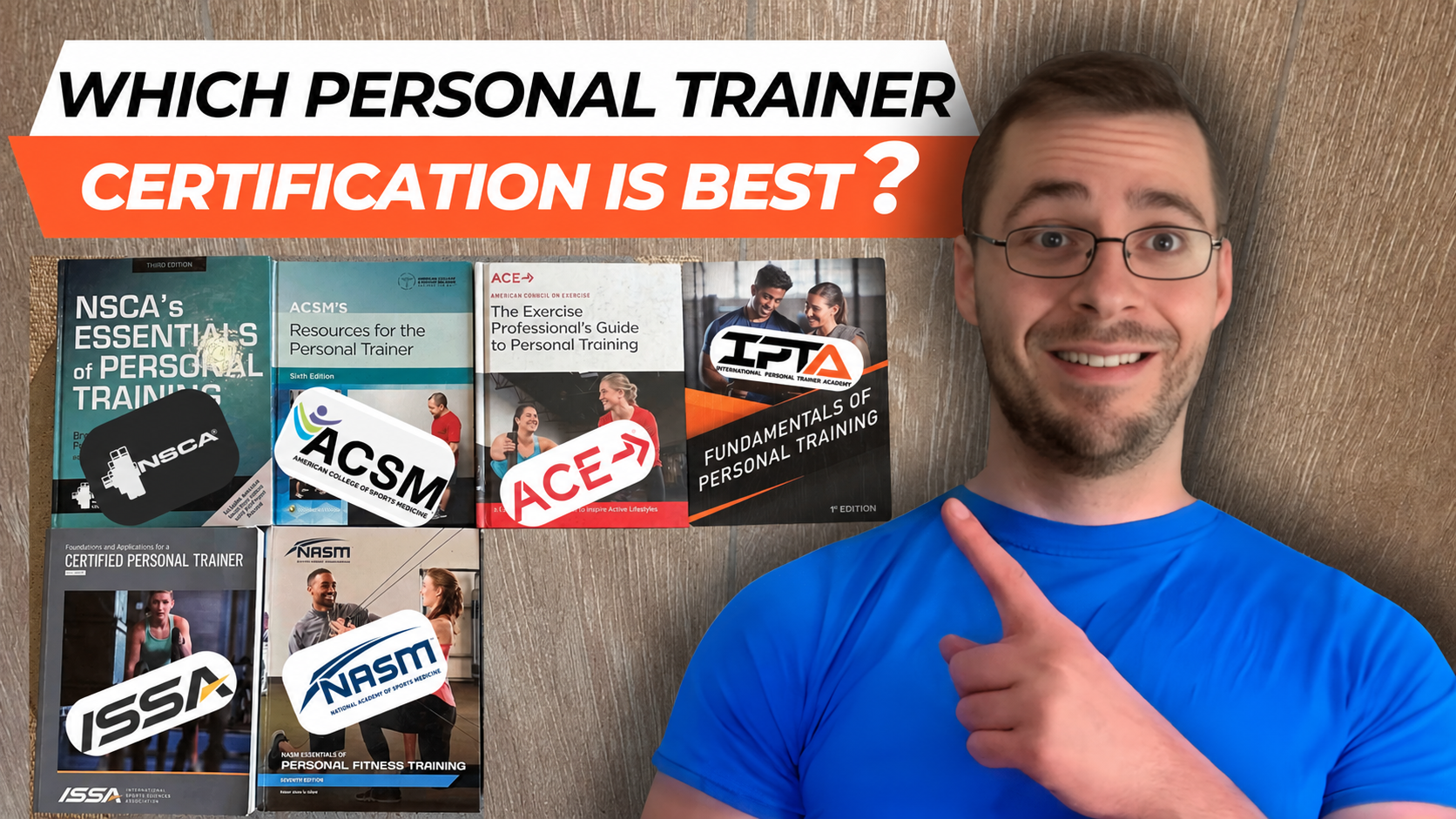



The 6 Best Personal Trainer Certifications in 2026
I recommend that you take our quiz to find the best PT certification for you.
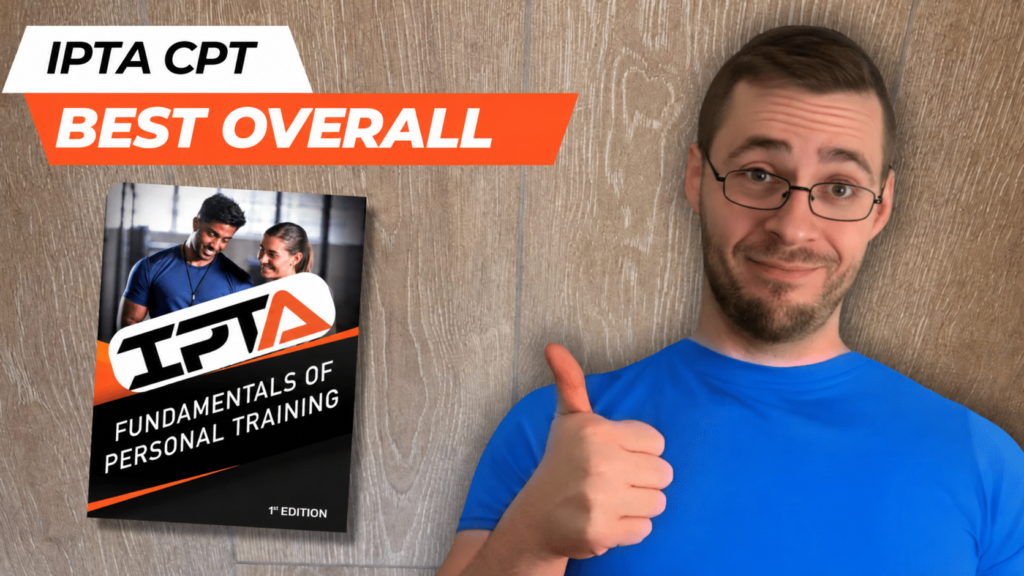
- Best overall certification: IPTA CPT – International Personal Trainer Academy – Check IPTA Pricing
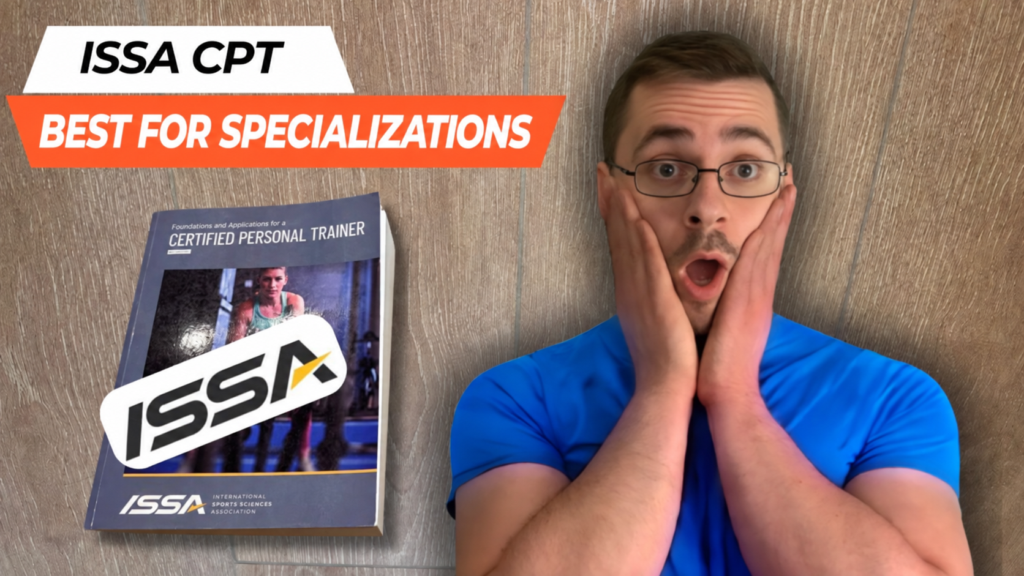
- Best for specializations: ISSA CPT – International Sports Sciences Association – Check ISSA Pricing
- Best training model: NASM CPT – National Academy of Sports Medicine – Check NASM Pricing
- Best for behavioral change: ACE CPT – The American Council on Exercise
- Best for training athletes: NSCA CPT – National Strength and Conditioning Association
- Best for Clinical Exercise: ACSM CPT – American Council of Sports Medicine
We have free and premium study for all certifications. Study Here.
Our Rating Methodology and Qualifications
Step 1: I’ve identified the top 15 certifications by combining expert recommendations, industry reports, and insights from online communities like Reddit. We also analyzed search trends and job market demand to ensure the selected programs are both reputable and aligned with industry needs, focusing only on accredited certifications.
Step 2: I then carefully evaluated these 15 options against 10 critical criteria, each weighed according to its importance from our team’s collective experience. By sharing insights from our own journeys and lessons learned, together we narrowed it down to the top six, ensuring that our recommendations are both practical and personally tested. Here are the top 10 criteria:
Read much more about our criteria here
Step 3: Every figure in this article was checked against the certifying body’s own published information in September 2026, rather than carried over from a previous version.
| Criterion | Weight | Leader |
|---|---|---|
| NCCA Accreditation | 20% | Tie, all six |
| Total Cost Over Time | 20% | IPTA |
| Study Materials and Support | 17% | IPTA |
| Expected Study Time | 10% | Tie |
| Job Guarantee and Earning Potential | 7% | Tie: IPTA, ISSA, NASM |
| Certification Bonuses | 7% | IPTA |
| Payment Options | 6% | NASM |
| Exam Pass Rate | 5% | Tie: ISSA and IPTA |
| Certification Popularity | 5% | NASM |
| Certification Focus | 3% | Tie |
IPTA leads the categories worth 44% of the rating, including the two heaviest. NASM leads 11%. The remaining 45% is a genuine tie, which is what you would expect from six programs that all meet the same accreditation standard.
IPTA (International Personal Training Academy) is the best personal trainer certification for most people in 2026. It offers the lowest entry price of any NCCA-accredited option at $399, the highest-rated study materials in this comparison, and an MVP tier at $799 that includes unlimited free exam retakes and a free first recertification. ISSA is the strongest choice for stacking multiple credentials, and NASM carries the widest employer recognition. All six certifications reviewed here are NCCA accredited.
Why We Are Qualified to Rank the Top Personal Trainer Certifications
Hi, I’m Dominic Angelino. With over a decade of experience in the fitness industry and a solid background in exercise science, I’ve dedicated my career to understanding and teaching the nuances of personal training.
This article has also been reviewed by Tyler Read, a personal training certification expert with over 10 certifications and the owner of PTPioneer.com, bringing a wealth of knowledge to ensure the accuracy and depth of our analysis.
Our rankings are the result of collaboration across the entire Trainer Academy staff, who collectively bring over 100 years of personal training experience and hold 15 certifications. Our team’s extensive expertise spans leadership roles, education, and hands-on training, allowing us to provide a thorough and reliable evaluation of the top personal trainer certifications.
One disclosure worth making up front: Trainer Academy operates IPTA, and IPTA’s study materials are included in the comparison below. We have scored it on the same ten criteria as everything else, and where a competitor beats it, we say so.
Also, check out my article on the best nutrition certifications.
Personal Trainer Certification Reviews
Best overall: IPTA Certified Personal Trainer
PROS
CONS
Summary:
- Accreditation options: NCCA Only
- Cert Combo packages: BOGO, IPTA Triple Stack (Check them out here)
- Starting price: $399
- Exam Pass Rate: 75%
- Gym acceptance: Accepted at all gyms
- Average study time: 2-3 months
- Payment options: One-time, Financing
IPTA is a personal trainer certification from the International Personal Training Academy, NCCA-accredited and built around a mobile-first study platform that uses AI-powered adaptive learning and science-backed study techniques to streamline exam prep. It is the newest organization in this comparison, though it’s backed by over a decade of expertise developing study materials for top fitness certifications.
The exam on its own is $399 and includes the CPT textbook for free, which makes it the cheapest route to an NCCA-accredited credential of any program here. Aspiring trainers can also try the study system risk-free, with no payment info required, before enrolling.
- The Rookie tier is $449 and adds an interactive study guide.
- All-Star is $599 and adds an exam simulator and a flashcard system.
- MVP is $799, discounted from a $999 list price, and adds unlimited exam retakes, the free first recertification, the SurePass AI study suite, the Job Assurance guarantee and a free professional website, discounted insurance, free CPR/AED certification, 8 business courses, and a free CEU course of your choice.
Thanks to its adaptive learning approach, the average IPTA candidate is exam-ready in two to three months and can start training clients in just a few weeks, against four to six months for most programs here.
The exam is proctored, taken online or at a testing center. IPTA does not offer a non-accredited alternative, so there is one exam and it is the accredited one. Retakes are unlimited and free at the MVP tier, which is the only certification in this comparison where a second attempt costs nothing.
IPTA is best for someone who wants an accredited credential at the lowest possible entry price, or who wants the most complete, technology-driven study system available and is comparing at the $800 mark rather than the $450 one.
Best for specializations: ISSA Certified Personal Trainer
PROS
CONS
Summary:
- Accreditation options: NCCA and Non NCCA
- Cert Combo packages: Yes: Elite trainer, Master trainer, Bogo
(Check them all out here) - Starting price: $828
- Exam Pass Rate: 75%
- Gym acceptance: Accepted at all gyms
- Average study time: 3 months
- Payment options: One-time, Financing
ISSA is a personal trainer certification from the International Sports Sciences Association, founded in 1988, with the largest catalog of stackable specializations of any organization here and the only NBFE accreditation alongside NCCA. It is the certification we recommend to anyone planning to build a career on more than one credential, and its combo packages are the best structured on this list.
The cost is $868, discounted from a $1,068 list price. That is one package, not a range. A twelve-month plan is available at $49 today plus twelve payments of $92, which totals $1,153, so paying monthly costs $285 more than paying once. A retake is $99, and recertification is $99 every two years, but waived if every CEU is earned through ISSA. Against IPTA, ISSA costs $150 more to start and scores lower on study materials, 8 out of 10 versus a perfect 10.
Study time is around three months on average, with no deadline to sit the exam.
ISSA runs two exam pathways, and the difference matters. The NCCA-accredited exam is proctored and closed book, delivered through its NCCPT subsidiary. ISSA also sells a non-accredited open-book exam. The high pass rates quoted around ISSA attach to the open-book route, not the accredited one, so treat them with care. If you are certifying to work in a gym, the proctored exam is the one you want.
ISSA’s business skills coverage is genuinely strong, and ISSA-certified trainers tend to earn some of the highest compensation compared to peers with other certifications, likely thanks to that emphasis on sales and business fundamentals. The curriculum also has great coverage of special populations training and aerobic exercise physiology, which is valuable given how common cardiorespiratory and metabolic disease is among clients seeking a trainer. Its weaker spots are corrective exercise, often needed for clients who must restore muscle balance before heavy training, and behavioral change coaching, which matters for client retention once exercise adoption has been achieved.
ISSA is best for anyone planning to hold more than one credential. If you intend to add nutrition, corrective exercise or group fitness over the next few years, buying them from ISSA together is the best-structured deal here.
Best training model: NASM CPT

PROS
CONS
Summary:
- Accreditation options: NCCA and Non NCCA
- Cert Combo packages: Yes: CPT Pro bundle (CPT, CNC, CES +CPR)
(Check it out here) - Starting price: $999
- Exam Pass Rate: 64.3%
- Gym acceptance: Accepted at all gyms
- Average study time: 4 months
- Payment options: One-time, Financing
NASM is the most widely recognized certification in the industry, built around its Optimum Performance Training model and a strong corrective-exercise curriculum. Founded in 1987 to push the fitness industry toward more evidence-based practices, NASM has continued to set a high standard in fitness education, and hiring teams often place high value on NASM-certified trainers, prioritizing them over candidates with less-recognized certifications.
The Self-Study is $999 and is not currently discounted.
– Premium Self-Study is $1,243, reduced from $1,399.
– CPT Essentials is $1,357, reduced from $2,547.
– CPT Exclusive is $1,417, reduced from $3,446.
Note the shape of that: the entry tier holds its price while the upper tiers are discounted 11%, 47% and 59%, which currently puts Premium only $244 above Self-Study. If you are buying NASM, the upper tiers are unusually good value right now relative to the base.
Study time is around four months typically, which tracks with the exam’s university-level depth of content and its emphasis on understanding the reasoning behind each training principle rather than just memorizing it.
The exam is 120 questions, closed book, proctored, two hours, and a scaled passing score of 70. A retake is $199. NASM also offers a non-accredited open-book option.
For trainers who want to go further, NASM’s specialization courses, such as Corrective Exercise Specialist or Performance Enhancement Specialist, are strong paths that can boost both credibility and income potential, and the CPT and Nutrition Coach bundle pairs fitness training with nutritional guidance for those wanting a more complete approach to client outcomes.
NASM is best for a trainer who wants the name a hiring manager will recognize immediately, or who wants to spread payments without paying a premium for the privilege.
Best for Behavioral Change: ACE CPT

PROS
CONS
Summary:
- Accreditation options: NCCA and Non NCCA
- Cert Combo packages: No
- Starting price: $593
- Exam Pass Rate: 65%
- Gym acceptance: Accepted at all gyms
- Average study time: 6 months
- Payment options: One-time, Financing
ACE is a long-established nonprofit whose curriculum centers on behavior change, client adherence and lifestyle coaching. Founded in 1985, ACE is among the few certifications with a dedicated focus on behavior change through its Mover Model, a framework for guiding clients toward sustainable lifestyle changes, and this emphasis on client psychology over strict physiology is what sets it apart from programs like ISSA or NASM.
In terms of pricing, the Basic is $494.50, reduced from $989.
– Plus is $584.50
– Advantage is $874.50.
The NCCA-accredited exam is not included in any package and costs $99 extra, so the real prices are $593.50, $683.50 and $973.50. The packages include a non-proctored certificate exam of 100 questions instead, which is not the credential most employers ask for.
Most candidates finish studying for the exam within six months. ACE also leans on its Integrated Fitness Training Model, which offers a “plug-and-play” exercise library organized by phase, making program design more accessible than in some other certifications, especially for trainers just starting out.
The accredited exam is 150 questions, proctored, and scored on a scale where 500 of 800 passes. A retake costs $249, the second most expensive in this comparison after NSCA. As a nonprofit, ACE also maintains partnerships with universities, so students in ACE-aligned coursework can finish ready to sit the exam.
ACE is best for a trainer heading toward health coaching, corporate wellness, or work with clients who struggle with adherence rather than with programming.
Best for Training Athletes: NSCA CPT

PROS
CONS
Summary:
- Accreditation options: NCCA Only
- Cert Combo packages: No
- Starting price: $703
- Exam Pass Rate: 58%
- Gym acceptance: Accepted at all gyms
- Average study time: 6 months
- Payment options: One-time Only
NSCA is the strongest name in strength and conditioning and the direct pathway to the CSCS, the industry standard for working with athletes. Founded in 1978, its CPT is the most science-heavy certification in this group, with a deep dive into strength and conditioning principles that gives it a performance-focused edge over more clinical certifications like ACSM or behavior-based ones like ACE.
NSCA sells the exam and the study materials separately, and prices both by membership. The exam is $435 non-member or $300 member.
– The Essential Collection is $346 non-member or $273 member.
– The Platinum Collection is $585 or $480. A realistic non-member total is $781.
Membership is itself a purchase at $130 a year for a professional membership, so the cheapest genuine member route is $703 rather than $573. The member discount is smaller than it first appears.
Study time is around six months, longer than most programs here. Unlike NASM’s OPT model, which offers a clear progressive structure, NSCA’s programming framework leaves much of the work of combining strength, endurance and hypertrophy goals up to the trainer, which can feel daunting early on but tends to build a deeper, more adaptable level of programming skill over time.
The exam is 155 questions with 15 unscored, and a scaled passing score of 70. The exam is in-person only. NSCA is the one certification here with no online proctored option.
A retake costs the full exam fee again, $435 for a non-member. That is by far the most expensive retake in this comparison, against ISSA’s $99, NASM’s $199, ACSM’s $205 and ACE’s $249.
NSCA is best for someone who intends to work with athletes, or who plans to progress to the CSCS.
Best for Clinical Exercise: ACSM CPT

PROS
CONS
Summary:
- Accreditation options: NCCA Only
- Cert Combo packages: No
- Starting price: $565
- Exam Pass Rate: 54%
- Gym acceptance: Accepted at all gyms
- Average study time: 6 months
- Payment options: One-time Only
ACSM is a research organization founded in 1954, and its CPT is the standard credential for clinical, medical and hospital-adjacent fitness work. As a nonprofit that contributes significant research and scientific literature to the field, ACSM lends its CPT a strong reputation, particularly for trainers considering a more clinical focus, though it’s less centered on advanced programming techniques than certifications like NASM or NSCA.
Price-wise ACSM unbundles everything, and the advertised figures leave out the material you need to pass. The exam is $410 non-member, including a $50 non-refundable application fee, or $310 for members, and buys nothing to study from.
- The Prep Bundle at $559 adds a prep course but still no textbook.
- The Prep Bundle Plus at $609 adds a practice test.
- ACSM expects candidates to read two textbooks on top of any of them: Resources for the Personal Trainer at $92 and Guidelines for Exercise Testing and Prescription at $63, a further $155. That makes the realistic figures $565 to sit the exam, $714 for the Prep Bundle and $764 for the Prep Bundle Plus.
Study time is four to six months depending on your background. The curriculum’s emphasis on fitness testing and exercise prescription prepares trainers well for clients managing chronic issues like diabetes, heart disease and obesity, making it a strong fit for anyone working with the general population’s health-related concerns rather than high-performance athletic goals.
The final exam is proctored and closed book. A retake is $205.
Recertification happens every three years and costs $60.
ACSM is best for a trainer aiming at clinical or medical settings, or one who already holds an exercise science degree and wants a credential that matches it.
Where Does Each Certification Score on our Key Criteria?
In this section we will do a deep dive our 10 rating criteria (and their rating weight %) for the 6 certifications on the list.
| Criterion | Weight | Leader |
|---|---|---|
| NCCA Accreditation | 20% | Tie, all six |
| Total Cost Over Time | 20% | IPTA |
| Study Materials and Support | 17% | IPTA |
| Expected Study Time | 10% | Tie |
| Job Guarantee and Earning Potential | 7% | Tie: IPTA, ISSA, NASM |
| Certification Bonuses | 7% | IPTA |
| Payment Options | 6% | NASM |
| Exam Pass Rate | 5% | Tie: ISSA and IPTA |
| Certification Popularity | 5% | NASM |
| Certification Focus | 3% | Tie |
Accreditation
Worth 20%, the joint-heaviest category, and every certification here clears it.
| Certification | NCCA | DEAC | NBFE |
|---|---|---|---|
| IPTA | ✓ | ✗ | ✗ |
| ISSA | ✓ | ✗ | ✓ |
| NASM | ✓ | ✗ | ✗ |
| ACE | ✓ | ✗ | ✗ |
| NSCA | ✓ | ✗ | ✗ |
| ACSM | ✓ | ✗ | ✗ |
NCCA accreditation is the standard gyms, studios and liability insurers actually check, and all six hold it. That is why this category carries the most weight and settles nothing: it is the reason none of these six will hold you back with an employer, and the reason the ranking is decided elsewhere.
ISSA is the only one carrying a second accreditation, NBFE, which is a genuine point in its favour. None of the six holds DEAC alongside NCCA.
One thing to watch. ISSA, NASM and ACE each sell a non-accredited exam alongside the accredited one, and in ACE’s case the non-accredited version is the one included in the packages. IPTA, NSCA and ACSM run the accredited exam only, so there is no wrong option to pick.
Total Cost Over Time
The typical personal trainer certification cost ranges from $399-$1243 for a quality NCCA-accredited personal training certification and associated study materials. The better way to compare price is tier by tier, because comparing one organization’s top package with another’s entry package tells you nothing.
Note that ACE’s NCCA exam is a $99 add-on at every tier, so it is included in every ACE figure below. ACSM sells no study material with its exam and no textbooks with its bundles, so its two required textbooks, $155 together, are included in every ACSM figure below.
Cheapest route to sitting the accredited exam:
| Certification | Cost |
|---|---|
| IPTA | $399 |
| ISSA | $868 |
| NASM | $999 |
| ACE | $593.50 |
| NSCA | $781 |
| ACSM | $565 |
IPTA wins out here, by giving you the textbook for free, which you can use to study for the exam.
Entry study package:
| Certification | Cost |
|---|---|
| IPTA | $449 |
| ISSA | $868 |
| NASM | $999 |
| ACE | $593.50 |
| NSCA | $781 |
| ACSM | $691 |
Once again, IPTA is the least expensive option.
Mid-range study package:
| Certification | Cost |
|---|---|
| IPTA | $599 |
| ISSA | $868 |
| NASM | $1,243 |
| ACE | $683.50 |
| NSCA | $781 |
| ACSM | $714 |
IPTA’s All-Star tier at $599 includes the textbook, an interactive study guide, an exam simulator and a flashcard system. ACE’s equivalent Plus package costs $84.50 more once the exam is added, and ACSM’s costs $92 more once the textbook is.
Top package:
| Certification | Cost |
|---|---|
| IPTA | $799 |
| ISSA | $868 |
| NASM | $1,417 |
| ACE | $973.50 |
| NSCA | $1,020 |
| ACSM | $764 |
This is the one tier where IPTA does not technically cost the lowest, and the gap is $35. However, ACSM’s top tier study program only gives you a prep course, one practice test and two textbooks, with a $205 fee if you fail. IPTA’s $799 MVP includes unlimited free retakes, a free first recertification, the SurePass AI suite, the Job Assurance guarantee and free CPR/AED certification. The same comparison applies to NSCA’s Essential route at $781, which buys five things: a textbook, a study guide, quizzes, one practice exam and the exam itself.
In terms of what you get in the highest tiers, IPTA, ISSA, NASM, and ACE add in the most extras whereas both NSCA and ACSM’s “top tiers” are still pretty basic.
First-cycle total, adding one retake and the first recertification:
| Certification | Total |
|---|---|
| IPTA | $799, recertification free |
| ISSA | $967 |
| NASM | $1,516 |
| ACE | $1,102.50 |
| NSCA | $1,082 |
| ACSM | $824 |
The winner here is IPTA. It has the lowest entry price of the six, the cheapest package at every tier a candidate actually buys, and the only free first recertification. ACSM’s fullest bundle is $35 cheaper on the package alone, and $25 more expensive once you count recertification.
Study Materials/Support
We’ve dedicated 17% of our rating criteria to evaluating the quality of certification study materials and support. These components are vital for a student’s success, not only in passing the exam but also in ensuring they are well-prepared to excel as competent personal trainers.
| Certification | Study materials |
|---|---|
| IPTA | 10/10 |
| ISSA | 8/10 |
| NASM | 8/10 |
| ACE | 6/10 |
| NSCA | 5/10 |
| ACSM | 5/10 |
IPTA takes this on the strength of its MVP tier, which pairs a digital textbook with an exam simulator, a flashcard system, an audio study guide, performance reporting, weak-point training, tailored study plans and the SurePass AI engine that reschedules your study as your quiz results change. The two-point gap to the next best is the widest margin anywhere in this comparison.
Certification Support Details:
On support, IPTA and ISSA are the only two offering live chat, email, phone and 24-hour cover, and IPTA answers fastest at 25 minutes against ISSA’s 30.
IPTA scores top marks again.
Payment Options
Worth 6%, and the results here are not what the marketing suggests. We checked each plan’s total against the price of paying once.
| Certification | Outright | Plan total | Difference |
|---|---|---|---|
| IPTA | $799 | $958 | $159 more |
| ISSA | $868 | $1,153 | $285 more |
| NASM | $999 | $998 | None |
| ACE | $584.50 | around $763 | around $179 more |
| NSCA | n/a | No plan offered | n/a |
| ACSM | n/a | No plan offered | n/a |
NASM is the only certification here whose payment plan costs nothing extra. IPTA’s plan is MVP-only and adds does not factor in the reduced $799 rate. ISSA’s adds $285 despite being advertised as 0% interest. NASM is the clear winner here.
Exam Pass Rate + Exam Info
I identified that the exam pass rate significantly influences the choice of certification organization, accounting for 5% of our rating criteria. This reflects not only how well each organization prepares its students but also accounts for the test anxiety, which can vary significantly.
| Certification | Pass rate |
|---|---|
| IPTA | 75% |
| ISSA | 75% |
| NASM | 64.3% |
| ACE | 65% |
| NSCA | 58% |
| ACSM | 54% |
ISSA and IPTA lead, ten points clear of ACE in third. Because they are level, this category does not separate the top two.
Overall, this is a tie between ISSA and IPTA
Expected Study Time
The estimated required study time for each certification can significantly impact your decision-making process. From our experience, time is indeed money, and the quicker you can prepare and pass your exam, the sooner you can start earning as a personal trainer. Consequently, estimated study time comprises 10% of our rating criteria.
| Certification | Typical time to exam |
|---|---|
| IPTA | 2 to 3 months |
| ISSA | 3 months |
| NASM | 4 months |
| ACE | 6 months |
| NSCA | 6 months |
| ACSM | 4 weeks to 6 months |
IPTA is the fastest on this page, and the gap comes from IPTA’s online study system rather than from less content. The AI-powered program identifies your weak points as you study so you can learn key concepts more quickly. The study plan also adapts to your schedule so most candidates are ready for the exam a month sooner than ISSA or NASM.
Most organizations allow up to six months to sit the exam regardless of how quickly you are ready.
Job Guarantee/Earning Potential
From our extensive experience, one of the most valuable features an organization can offer is a job guarantee with their certification packages. The ability to secure employment quickly can significantly enhance your earning potential by allowing you to start your career earlier, gain more experience, and increase your overall earnings. This factor contributes to 7% of our rating criteria.
| Certification | Job guarantee |
|---|---|
| IPTA | Job Assurance guarantee, MVP tier only |
| ISSA | Job guarantee through around 10,000 US gym partners |
| NASM | Job guarantee on Premium Self-Study and above |
| ACE | Job board, which is not a guarantee |
| NSCA | None |
| ACSM | None |
Three of the six offer a genuine placement guarantee.
The only full fledged job guarantees are provided by NASM, ISSA and IPTA. But we aware that NASM only offers them on their higher priced packages.
On earnings, the published figures vary widely depending on who is counting:
| Source | Average annual salary |
|---|---|
| U.S. Bureau of Labor Statistics | $40,700 |
| ZipRecruiter | $51,140 |
| Indeed | $60,219 |
| Glassdoor | $61,815 |
| Salary.com | $65,033 |
Treat these as a range rather than a number. What moves a trainer up it is specialization, retention and the ability to sell, none of which is decided by which of these six certifications is on the wall.
Certification Bonuses
Worth 7%. IPTA’s MVP tier includes a free professional website, eight business courses, a CEU specialty course, free CPR/AED certification and discounted insurance, alongside the free first recertification and unlimited retakes. That is more included value than anything else here at any price.
ISSA counters with the best combo packages, and if your plan is to hold several credentials that structure beats a longer list of single-cert extras.
| Certification | Bonuses included | Available on |
|---|---|---|
| IPTA | Free CPR/AED, professional website, 8 business courses, a CEU specialty course, discounted insurance, free first recertification, unlimited retakes, Job Assurance | MVP tier only |
| ISSA | Free CPR/AED, professional website, unlimited post-certification support, CPT Education Bootcamp, job guarantee | Included |
| NASM | Edge App, job guarantee, free CPR/AED | Premium Self-Study and above |
| ACE | Pro Career Support, job board (not a guarantee), CPR/AED | Selected packages |
| NSCA | None | — |
| ACSM | None | — |
IPTA wins on volume of inclusions and ISSA on bundle structure.
Certification Popularity
The popularity of a certification accounts for 5% of our overall rating criteria. In my experience, there are instances where a gym or fitness club may have a strong preference for one certification over another. However, this doesn’t necessarily mean that employers only favor certifications based on popularity.
More commonly, employers prioritize whether a certification is accredited by the NCCA, rather than focusing solely on its recognition or brand. This highlights the importance of accreditation over simple name recognition in many hiring decisions.
I’ve utilized two key metrics to capture certification popularity:
- The number of exam attempts per year as reported by the certifying organizations.
- The volume of monthly Google searches for each certification. We gathered this data using AHREFS, a marketing tool that estimates monthly search traffic.
By leveraging these metrics, I’ve ensured a thorough analysis of how well-known each certification is within the industry.
| Certification | Exam attempts per year | Searches per month |
|---|---|---|
| IPTA | Not published | 200 |
| ISSA | 10,696 | 900 |
| NASM | 31,385 | 4,800 |
| ACE | 11,835 | 700 |
| NSCA | 1,529 | 400 |
| ACSM | 1,386 | 300 |
NASM wins this outright and it is not close. IPTA is the newest name here and has the search volume to match. This is exactly why popularity carries 5% of the rating and cost over time carries 20%: employers ask whether a certification is NCCA accredited far more often than they ask whose logo is on it.
Certifications Focus
Worth 3%, the lightest category, because it is the most subjective.
| Certification | Focus |
|---|---|
| IPTA | The latest exercise science, delivered for self-paced study |
| ISSA | Designing fitness programs and building a business |
| NASM | Client relationships and teaching exercise technique |
| ACE | Behavior change and exercise adherence |
| NSCA | Exercise methodology and programming for performance |
| ACSM | Clinical application and educating clients |
Every one of these covers the same core ground, because NCCA accreditation requires it. The differences are in emphasis, and emphasis matters less than most buyers expect. A trainer who wants to work with athletes will get further with NSCA’s curriculum, and one heading for behavior-change work will get further with ACE’s, but none of the six will leave you unable to do the job.
Pick on the destination you have in mind, not on the syllabus.
How to Choose the Right Certification for You
Start with your budget, because it eliminates the most options fastest.
If your ceiling is around $450, there are two routes and they are close on price. IPTA’s $399 exam-only option gets you an accredited credential with the textbook included. ACSM’s $410 gets you the exam alone, with no study materials at all, so you would be buying a textbook on top. IPTA is the better buy at that level, and if you want an actual study system rather than a book, its $449 Rookie tier is the next step up.
If you can spend around $800, the question becomes what you get for it. IPTA’s MVP tier and NSCA’s non-member package are within $18 of each other and are not remotely comparable in contents. IPTA gives you twenty-four bonuses, among them adaptive study tooling, unlimited free retakes and a free first recertification. NSCA gives you: a textbook, a study guide, quizzes, one practice exam and the exam, and charges $435 if you fail. Choose NSCA anyway if you are heading for athletic performance work and the CSCS, because the curriculum is built for it.
If you want the name, buy NASM. It has more than twice the exam volume of anything else here and the widest recognition among commercial gyms. Its payment plan is also the only genuinely interest-free one in this comparison.
If you plan to collect credentials, buy ISSA. One provider, the deepest catalog, and bundle pricing that no one else matches.
If you are comparing mid-range packages, IPTA’s All-Star at $599 is the cheapest of the six. ACE’s Plus is $683.50 once the NCCA exam is added, and ACSM’s Prep Bundle is $714 once its two required textbooks are. Both advertise lower numbers than that, which is the thing to watch for.
If you are aiming at a specific setting, the specialist answers hold. ACE for behavior change and health coaching. NSCA for athletes. ACSM for clinical and medical work.
One thing not to weigh too heavily: all six are NCCA accredited, which is the standard gyms and insurers actually check. None of them will cost you a job.
Best CPTs Conclusion
IPTA is the best personal trainer certification for most people in 2026. It has the lowest entry price of the six at $399 with the textbook included, the highest-rated study materials by a two-point margin, and an MVP tier at $799 that no other program matches for included value.
It does not win everything. ACSM’s fullest bundle is $35 below IPTA’s MVP tier on sticker price, and if you pass first time that gap holds. NASM has the recognition and the only genuinely interest-free payment plan. ISSA has the catalog.
Choose on the basis of what you actually need, and use the criteria above rather than the logo.
Choosing the right personal training certification is not only about prestige but also about its practical impact in an industry worth over $14 billion in 2024. With the demand for personal trainers projected to grow by 14% by 2034, the need for well-qualified trainers is clear.
Good luck becoming a personal trainer.
Frequently Asked Questions (FAQs)
What is the best personal trainer certification?
IPTA, for most people in 2026. It has the cheapest accredited entry price at $399 with the textbook included, the highest study materials rating in this comparison, and the most complete package at $799. ISSA is better if you want several credentials and NASM is better if you want maximum employer recognition.
What is the cheapest personal trainer certification?
IPTA at $399 for the exam with the CPT textbook included, which is the lowest entry price of any NCCA-accredited option here. IPTA is also cheapest for a full study package, at $449 for Rookie and $599 for All-Star.
How much does it cost to become a personal trainer?
Between roughly $400 and $1,000 for an accredited certification with study materials. Budget also for a retake, which ranges from free at IPTA’s MVP tier to $435 at NSCA, and for recertification every two or three years.
What is the Hardest Personal Trainer Certification?
The NASM, ACSM, and NSCA personal trainer certifications are arguably the hardest in the industry, followed by ISSA. All of these certifications are difficult, however, but they prepare you well for a career as a personal trainer.
Are all of these certifications NCCA accredited?
Yes. All six hold NCCA accreditation, which is the standard most gyms, studios and liability insurers check. Note that ISSA, NASM and ACE also sell non-accredited exam options, and those are not the credential employers recognize.
Which personal trainer certification is easiest to pass?
ISSA and IPTA lead the pass rate table above, ten points clear of ACE in third. Compare pass marks carefully though: NASM and NSCA both require a scaled score of 70, which is not a percentage, and ACE requires 500 of 800.
Do I need a college degree to be a personal trainer?
No. All six certifications require only a high school diploma or equivalent, a current CPR/AED certification, and a government-issued ID.
How long does it take to get certified?
Two to three months for IPTA, three for ISSA, four for NASM, and around six for ACE, NSCA and ACSM. Most organizations allow up to six months to sit the exam.
Which certification has the cheapest exam retake?
IPTA’s MVP tier includes unlimited retakes at no cost, the only certification here where a second attempt is free. Among the rest, ISSA is cheapest at $99, then NASM at $199, ACSM at $205 and ACE at $249. NSCA charges the full exam fee again, $435 for a non-member.
Can I make good money as a personal trainer?
Yes, you can make good money as a personal trainer. Earnings vary based on experience, location, and specialization, but successful trainers often earn a solid income through personal training sessions, group classes, and online coaching. Building a strong client base and expanding services can significantly increase your earnings.
How can you become a certified fitness trainer?
To become a certified fitness trainer: Choose an NCCA-accredited certification, meet prerequisites (like a high school diploma), study the required materials, pass the exam, obtain CPR/AED certification, and start training clients. Continuing education can further advance your career.
What skills are needed to become a trainer?
Knowledge of Exercise Science: Understanding anatomy, physiology, and proper exercise techniques.
Communication: Effectively instructing and motivating clients.
Adaptability: Customizing programs to meet individual client needs.
Problem-Solving: Addressing client challenges and adjusting plans.
Business Acumen: Managing schedules, marketing, and client relations.
Empathy: Understanding and supporting clients’ goals and struggles.
How long does it take to become a certified personal trainer?
Becoming a certified personal trainer usually takes 3 to 6 months, depending on the program and study time. Most certifications, like NASM and ACE, recommend 80 to 100 hours of study. IPTA students average two to three months. After completing your studies, you can schedule and pass the exam to get certified.
References
- Credentialing Excellence. NCCA Accreditation. Institute for Credentialing Excellence. https://www.credentialingexcellence.org/Accreditation/Earn-Accreditation/NCCA.
- National Board of Fitness Examiners (NBFE). NBFE Website. https://www.nbfe.org/.
- Distance Education Accrediting Commission (DEAC). DEAC Website. https://www.deac.org/.
- Wellness Creatives. Personal Training Industry Statistics. Wellness Creatives. https://www.wellnesscreatives.com/personal-training-industry-statistics/.
- RunRepeat. Personal Trainer Statistics. RunRepeat Website. https://runrepeat.com/personal-trainer-statistics.
- U.S. Bureau of Labor Statistics (BLS). Fitness Trainers and Instructors. Bureau of Labor Statistics Occupational Outlook Handbook. https://www.bls.gov/ooh/personal-care-and-service/fitness-trainers-and-instructors.htm. Published May 2023.
- Indeed. Personal Trainer Salaries. Indeed Website. https://www.indeed.com/career/personal-trainer/salaries.
- Glassdoor. Personal Trainer Salaries. Glassdoor Website. https://www.glassdoor.com/Salaries/personal-trainer-salary-SRCH_KO0,16.htm.
- ZipRecruiter. Personal Trainer Salaries. ZipRecruiter Website. https://www.ziprecruiter.com/Salaries/Personal-Trainer-Salary.
- Salary.com. Personal Trainer Salary. Salary.com. https://www.salary.com/research/salary/benchmark/personal-trainer-salary.
- Ahrefs. Ahrefs Website. https://ahrefs.com/.
- International Sports Sciences Association (ISSA). Personal Trainer Certification. ISSA Website. https://www.issaonline.com/certification/personal-trainer-certification.
- National Council on Strength and Fitness (NCSF). Personal Trainer Certification. NCSF Website. https://www.ncsf.org/personal-trainer/.
- National Academy of Sports Medicine (NASM). Become a Personal Trainer. NASM Website. https://www.nasm.org/become-a-personal-trainer.
- American Council on Exercise (ACE). Personal Trainer Certification. ACE Website. https://www.acefitness.org/fitness-certifications/personal-trainer-certification/default.aspx.
- American College of Sports Medicine (ACSM). Personal Trainer Certification. ACSM Website. https://www.acsm.org/certification/get-certified/personal-trainer.
- National Strength and Conditioning Association (NSCA). NSCA-CPT Certification. NSCA Website. https://www.nsca.com/certification/nsca-cpt/.
- Prometric. Prometric Website. https://www.prometric.com/.
- PSI Exams. PSI Exams Website. https://www.psiexams.com/test-takers/.
- ProctorU. ProctorU Website. https://www.proctoru.com/.
- Pearson VUE. Test Center Information. Pearson VUE Website. https://www.pearsonvue.com/us/en/test-centers.html.
- Wackerhage H, Schoenfeld BJ. Personalized, Evidence-Informed Training Plans and Exercise Prescriptions for Performance, Fitness and Health. Sports Medicine. 2021;51(9):1805-1813. doi: https://doi.org/10.1007/s40279-021-01495-w
- Sator M, Holler P, Rosenbaum M. National train-the-trainer certificate programme for improving healthcare communication in Austria. Patient Education and Counseling. Published online July 2021. doi: https://doi.org/10.1016/j.pec.2021.07.046
- Warburton DER, Charlesworth SA, Foulds HJA, McKenzie DC, Shephard RJ, Bredin SSD. Qualified exercise professionals. Canadian Family Physician. 2013;59(7):759-761. https://www.ncbi.nlm.nih.gov/pmc/articles/PMC3710048/
- Magal M, Neric FB. ACSM CERTIFICATIONS: DEFINING AN EXERCISE PROFESSION FROM CONCEPT TO ASSESSMENT. ACSM’S Health & Fitness Journal. 2020;24(1):12-18. doi:https://doi.org/10.1249/fit.0000000000000542
- Zenko Z, Ekkekakis P. Knowledge of Exercise Prescription Guidelines Among Certified Exercise Professionals. Journal of Strength and Conditioning Research. 2015;29(5):1422-1432. doi:https://doi.org/10.1519/jsc.0000000000000771
- Newsome AM, Reed R, Sansone J, Batrakoulis A, McAvoy C, W. Parrott M. 2024 ACSM Worldwide Fitness Trends: Future Directions of the Health and Fitness Industry. ACSM’s Health & Fitness Journal. 2024;28(1):14. doi:https://doi.org/10.1249/FIT.0000000000000933
- Paternostro Bayles M. Professional Certification. ACSM’s Health & Fitness Journal. 2010;14(6):42-43. doi:https://doi.org/10.1249/fit.0b013e3181f871b2